Petrol and diesel prices were on Thursday hiked by 80 paise a litre each, taking the total increase in rates in the last 10 days to Rs 6.40 per litre. Petrol in Delhi will now cost Rs 101.81 per litre as against Rs 101.01 previously while diesel rates have gone up from Rs 92.27 per litre to Rs 93.07, according to a price notification of state fuel retailers.

The state has not touched diesel prices, fearing losing revenue to neighbouring states

Tata Motors on Tuesday said it has reduced prices of its electric vehicle model range by up to Rs 3 lakh. The Mumbai-based automaker said it has reduced the price of Nexon EV by up to Rs 3 lakh, Punch EV by 1.2 lakh, and Tiago EV by Rs 40,000.

Petrol costs more in India than Pakistan.

Reliance Industries Ltd (RIL) on Friday reported a 9.6 per cent year-on-year rise in net profit for the September quarter, driven by strong performance in its consumer-facing retail and telecom businesses and a recovery in its core oil-to-chemicals segment.

Petrol price is to go up by 30 paisa per litre, diesel by 18 paisa as government decides to hike petrol pump dealers commission.
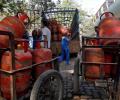
Cooking gas LPG prices may be hiked next week after under-recovery on the fuel widened to over Rs 100 per cylinder, sources said insisting that the rate hike, including the quantum of increase, is dependent on government permission. If allowed, this will be the fifth increase in cooking gas rates across all categories - households using subsidised gas for cooking and heating purposes, non-subsidised fuel and industrial-sized gas. LPG rates were last hiked by Rs 15 per cylinder on October 6, taking the total increase in rates since July to Rs 90 per 14.2-kg cylinder.

'What the US appears to be doing is to force India to be "the buyer of last resort", on whom their products can be dumped, 1.4 billion people have to eat something, so why not eat American corn?' 'What is exercising the Trump lot is the fact that most of the farms are in solidly Republican Midwestern states: Illinois, Indiana, Kansas, Michigan, Minnesota, Missouri, Nebraska, North Dakota, Ohio, South Dakota, Wisconsin,' points out Rajeev Srinivasan.
Taxes and duties on petrol and diesel in India are higher than developed countries like US and Japan and even neighbours like Pakistan, the Rajya Sabha was informed on Tuesday.
There are 42 countries where the fuels costs more than India.

Dr Manmohan Singh, the architect of India's economic reforms, had to literally face a trial-by-fire to ensure widespread acceptance of his path-breaking Union Budget of 1991 that saw the nation rise from its darkest financial crises.
Petrol and diesel prices were hiked by 80 paise a litre each on Wednesday, taking the total increase in rates in 16 days to Rs 10 per litre.

The new prices will be effective from Friday midnight.
A series of rises in petrol price following its decontrol on June 25 last year has increased the state governments' earnings from value added tax on petrol by around 21 per cent.
Although petrol prices are high in India, they are nowhere as high as in some countries in Europe.
Fuel prices are likely to be hiked again after the Parliament's Budget session ends on May 22.
US sanctions against two of Russia's largest oil companies are expected to impact Reliance Industries' crude imports from Russia, while state-run refiners may continue purchases through intermediary traders for now.

The revision in rates announced by Indian Oil Corp is excluding VAT and the actual change will be higher after considering them
After much persuasion by the UPA government in the aftermath of the petrol price hike, some Congress-ruled states made part-relaxations in taxes.

India's crude oil imports from Russia saw a marginal decline in September, but continued to account for over one-third of the country's total oil purchases, despite US pressure to curb the trade over concerns that it supports Moscow's war effort in Ukraine. India's crude imports in September were around 4.7 million barrels per day, up 220,000 bpd month-on-month and flat year-on-year.

The iconic brand is considering petrol powertrains for its entire Indian portfolio, which includes the Jeep Compass, Meridian, Grand Cherokee and Wrangler.
The new prices are effective from Sunday midnight.
Indian Oil Corporation (IOC) on Tuesday reported halving of its March quarter net profit largely because of losses in the petrochemical business and shrinking margin after it announced a pre-election fuel price cut despite rising input costs. The net profit of Rs 4,837.69 crore in January-March compared to Rs 10,058.69 crore a year back and Rs 8,063.39 crore in the preceding October-December quarter, according to a stock exchange filing by the company.
Earlier, the minister faced ire of Opposition members in Rajya Sabha as they accused him of not giving specific replies to questions on Aadhaar-based direct subsidy transfer to domestic cooking gas consumers.
While LPG price was raised by Rs 18, kerosene saw a hike of Rs 3 per litre
The relentless rise in international oil prices that last week touched an all time high of $135 a barrel has forced the government to mull options to save state-run firms, which expect a revenue loss of Rs 200,000 crore (Rs 2000 billion) this fiscal on sale of petrol, diesel, domestic LPG and kerosene.
The government is likely to give a subsidy of Rs 30,000-35,000 crore to state-run oil companies - Indian Oil Corporation (IOC), Bharat Petroleum (BPCL), and Hindustan Petroleum (HPCL) - to compensate for losses incurred from selling LPG at below cost over the past 15 months, according to a senior official.
The government on Thursday hiked petrol and diesel prices by a marginal Rs 0.27 a litre and Rs 0.15 per litre respectively following increase in the commission paid to petrol pump dealers.
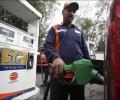
An Empowered Group of Ministers (EGoM) may go with Oil Minister Murli Deora's proposal to free petrol prices from government control, which would trigger a hike of Rs 3.73 a litre, official sources said.
State-owned oil companies on Wednesday raised the prices of petrol and diesel by Re 1 per litre each, effective from midnight.\n\n\n\n
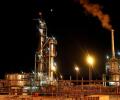
India, the world's third largest oil importing and consuming nation, is likely to save as much as Rs 1.8 lakh crore on import of crude oil and LNG if the trend of softening international energy rates continues, Icra said Wednesday. India, which meets over 85 per cent of its crude oil needs through imports, spent $242.4 billion on buying crude from overseas in the fiscal year ended March 31, 2025.

In the Upper House of Parliament, Chairman M Venkaiah Naidu did not allow adjournment notices moved by opposition members on the issue of price rise, prompting members of the Congress, the Trinamool Congress, the Left parties, the Dravida Munnetra Kazhagam, the Aam Aadmi Party, the Nationalist Congress Party, the Rashtriya Janata Dal and the Shiv Sena to create an uproar.

With rising petrol and diesel prices driving up demand for its CNG vehicles, the country's largest carmaker Maruti Suzuki India plans to widen its CNG portfolio by offering the fuel option in four more models 'very shortly', according to a senior company official. The company, which plans to launch an electric vehicle (EV) in the Indian market by 2025, is also currently keeping a close watch on the country's EV ecosystem "to find out what is the best way of evolution" to be able to offer affordable EVs with hassle free charging infrastructure in order to clock high volumes for a sustainable business.
The Cabinet, scheduled to meet on Thursday, may reduce petrol price by Rs 5 a litre, diesel by Rs 3 per litre and domestic LPG by Rs 25 per cylinder, giving relief to the common man and further easing inflationary pressures.

Russian oil giant PJSC Rosneft Oil Company is in early talks with Reliance Industries for sale of its 49.13 per cent stake in Nayara Energy, which operates a 20-million tonnes-a-year oil refinery and 6,750 petrol pumps in India, sources said. Reliance has held preliminary talks for acquisition of Nayara, which will help it overtake state-owned Indian Oil Corporation (IOC) to become India's No.1 oil refiner as well as give a meaningful presence in the fuel marketing space.
However, it may still not change its stance on the policy rate as inflationary pressures are coming from high commodity prices.
This is the steepest ever hike in rates.
From just 0.2 per cent before the Russia-Ukraine war to now accounting for 35-40 per cent of total crude imports, India's reliance on Russian oil has surged -- drawing fresh scrutiny with US President Donald Trump announcing a penalty on top of a 25 per cent tariff, or tax, on all goods going to the US.
Oil pricing freedom as an idea can succeed only if the ownership of the key oil refiners (read the public sector oil companies) ceases to be government-dominated.
